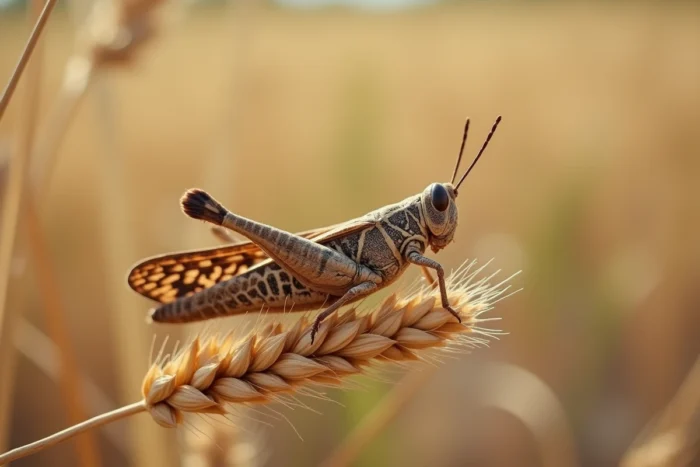
A brown grasshopper perched on the edge of a window, on the garage wall, or among the pots on the balcony: this scene repeats every summer in most French gardens. This omnipresence has a more nuanced explanation than mere seasonal coincidence. Behind the brown grasshopper lie biological mechanisms and factors related to our own landscaping.
Brown color of the grasshopper: a camouflage, not a separate species
Have you ever noticed that a green grasshopper and a brown grasshopper can look identical, except for their color? That’s normal. The brown hue does not identify a distinct species. In several orthopterans, color depends on the environment, season, and stage of development.
After a molt, the redistribution of pigments in the chromatophores can transform a green individual into a brown one. The same animal sometimes changes its appearance throughout its life. This phenomenon artificially inflates the number of brown grasshoppers we believe we observe: they are not necessarily different populations, but often the same individuals at another stage.
Brown offers a direct advantage: it blends in with dry soil, withered grasses, and bark. In summer, when vegetation turns yellow, brown-dominant grasshoppers are better protected from predators than their green counterparts. If you spot them more often, it’s also because the green ones go unnoticed in the foliage.
To learn everything about the brown grasshopper, you must first understand this color plasticity, which blurs the perception of the actual number of individuals.
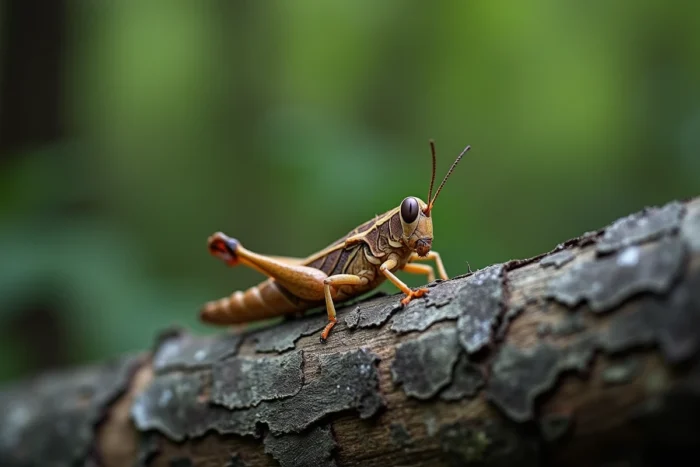
Gardens and suburban areas: why brown grasshoppers settle near houses
Grasshoppers don’t come to your home by chance. Our landscaping creates exactly the type of environment they seek.
Favorable micro-habitats in housing estates
A classic garden mixes mowed lawn, hedges, flower beds, wood piles, and low walls. This mosaic of textures and heights replicates what orthopterans find in natural wastelands. Embankments, terrace edges, and fence bases serve as refuges and laying areas.
Short lawns, in particular, expose the soil to sunlight. The accumulated heat accelerates the development of eggs laid in the ground. Brown grasshoppers, whose color blends with bare soil, find a double advantage there: protection and warmth.
Nocturnal lighting and light attraction
Garden lamps, wall sconces, and street lighting attract insects at night. Grasshoppers are no exception. Artificial lighting concentrates orthopterans near homes, which explains why they are found on walls, window sills, and sometimes inside houses.
Turning off unnecessary outdoor lights after a certain hour significantly reduces their presence near openings.
Expansion of grasshoppers in France: the role of climate change
The increasing frequency of observations is not just an impression. Several climatic factors play a measurable role.
- Longer and warmer summers extend the activity period of orthopterans, which remain visible later in the season.
- Mild winters reduce the mortality of eggs buried in the soil, increasing populations the following spring.
- Some Mediterranean species are gradually moving northward in France, colonizing areas where they were absent a few decades ago.
This last point is particularly striking for brown-dominant species, adapted to dry and open environments. The expansion northward follows the progression of arid soils and episodes of summer drought.
Brown grasshopper or cricket: a common confusion that skews the count
Many people call “grasshopper” any orthopteran that jumps in the grass. In reality, the majority of brown insects encountered in a garden are crickets, not grasshoppers.
Two simple criteria allow them to be differentiated:
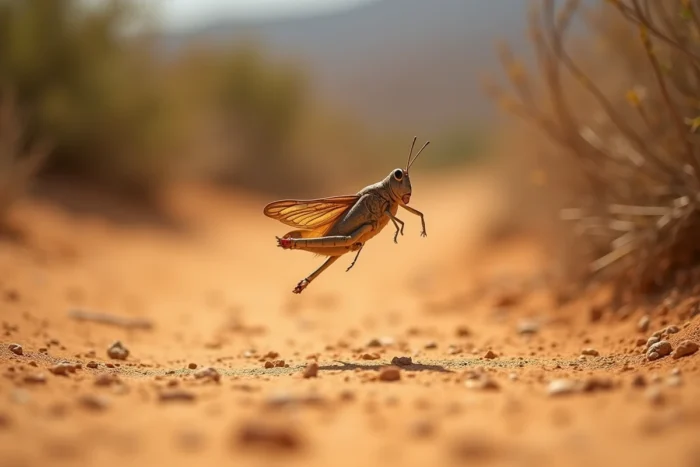
- The antennae: long and thin in grasshoppers (often longer than the body), short and thick in crickets.
- The diet: grasshoppers are largely omnivorous, even predatory of small insects. Crickets feed exclusively on plants.
- The female grasshopper has an ovipositor (sword-shaped laying organ) at the end of the abdomen, which is absent in crickets.
This confusion has a direct impact on perception: brown crickets, which are very numerous in meadows and lawns, are mentally counted as brown grasshoppers. The actual number of grasshoppers is therefore likely lower than what most observers estimate.
The brown grasshopper in the garden: useful or harmful?
Contrary to their reputation (inherited from the damage attributed to migratory locusts), grasshoppers are useful allies in the garden. They consume aphids, caterpillars, and other small pests. Their presence signals a diverse ecosystem.
They do not cause significant damage to vegetable crops or ornamental plants. Visible damage to leaves is almost always the work of crickets, which are strictly herbivorous and can nibble in groups.
If a grasshopper enters the house, it does not settle there. It seeks to go back outside. Leaving a window open or gently guiding it outside is enough. No chemical treatment is justified, and insecticides would harm the entire auxiliary fauna of the garden.
The next time a brown grasshopper lands on your arm or wall, look at its antennae. If they exceed the length of the body, it is indeed a grasshopper. If they are short, it is a cricket. In either case, the animal will leave on its own as soon as the light goes out.