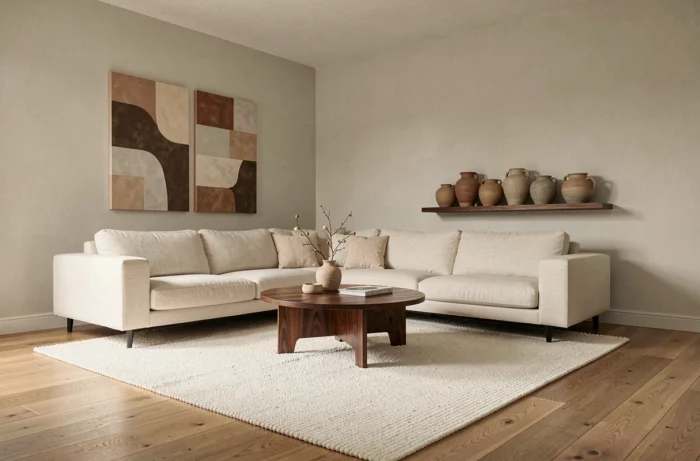
A sofa with clean lines, a wall painted in an earthy tone, a few thrifted objects on a walnut shelf: modern decoration is no longer just a catalog of trends to replicate. It raises a more demanding question about the real sustainability of the choices we make for our interiors. Between the structured reuse of furniture, new regulatory constraints on textiles, and the return of raw materials, the benchmarks are changing.
Reuse of furniture: decorating differently than with new items
Have you noticed that thrift stores and refurbished furniture platforms are multiplying? It’s no coincidence. The reuse of furniture has become a structured sector, with players who restore, control, and resell pieces ready to integrate into a living room or kitchen.
Decorating with reused furniture requires a few checks that are often overlooked. Before installing an antique dresser or a salvaged farmhouse table, you need to check the dimensions (a piece of furniture that doesn’t fit through the door is a classic issue), the structural condition, the strength of the joints, and for pieces intended for a communal space, the fire resistance.
The visual result is difficult to achieve with standardized new furniture. An authentic patina, wood marked by time, oxidized brass handles bring a depth to a piece that industrial finishes do not replicate. It’s a design choice that combines authenticity and a responsible approach.
To explore other creative avenues, decoration on 100,000 Watts regularly offers ideas that step outside the usual circuits.
Upholstery textiles and PFAS: what the law changes for your interior
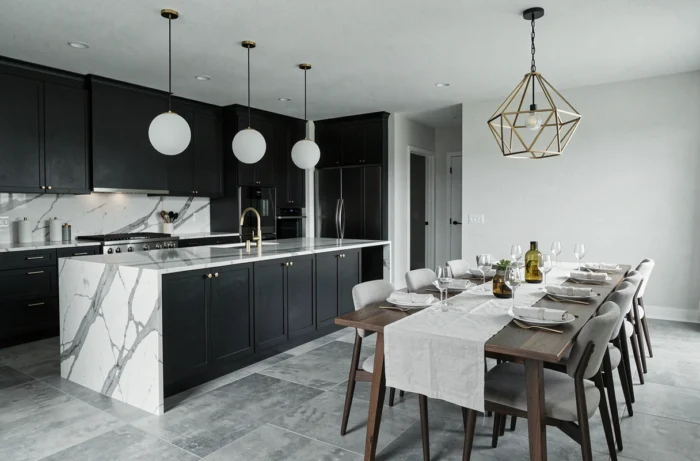
When choosing a sofa, curtain, or cushions, we think about color, texture, and comfort. Rarely about chemical composition. French law n° 2025-188 of February 27, 2025, changes the game. It regulates PFAS, these per- and polyfluoroalkyl substances used in certain stain-resistant and waterproof treatments applied to upholstery textiles.
The ban on PFAS will extend to upholstery textiles starting January 1, 2030. In practice, this means that the choice of a sofa fabric or cushion covering will need to consider the nature of the surface treatment, not just its appearance.
Why is this important for modern decoration? Because PFAS-treated fabrics are common in mid-range and high-end lines, precisely those associated with a well-kept interior. Here are the reflexes to adopt now:
- Check if the textile has a stain-resistant or waterproof treatment, and ask the manufacturer for the exact composition
- Favor untreated fabrics or those treated with fluorine-free alternatives, such as wax or silicone-based coatings
- Anticipate resale or donation: a textile containing PFAS will be more difficult to reuse after 2030
This criterion remains absent from most online decor content. However, it will become a selection filter as visible as color or pattern.
Raw materials and earthy colors in the living room
The living room remains the space where decor trends are most easily read. Right now, two directions are converging: raw materials left exposed (stone, polished concrete, unvarnished wood) and a color palette that draws from organic tones.
Specifically, this results in clay plaster walls in sandy or ochre shades, paired with natural stone or large-format tiles mimicking rock. The furniture follows the same logic: dark walnut or solid oak pieces, with curved shapes that soften the overall look.
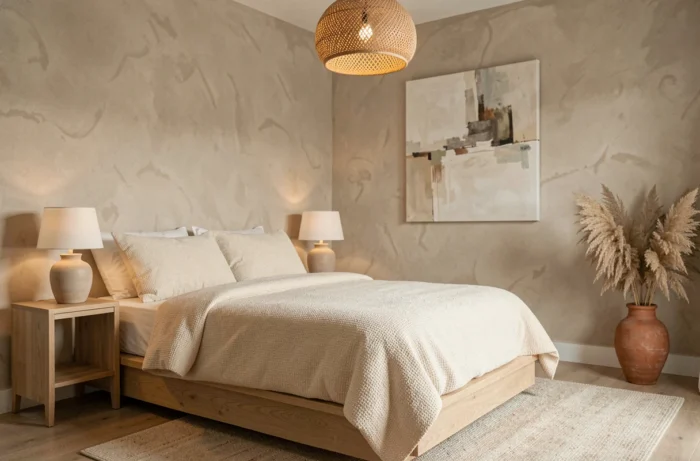
Why does this choice of palette work over time? Because an earthy tone does not go out of style like a trendy bright color for a season. Colors inspired by natural pigments (Sienna earth, clay, linen) endure through the years without giving the impression of a dated interior. It’s the difference between following a trend and building a lasting ambiance.
For the living room, a good starting point is to limit the palette to three close tones and introduce bright color in small touches: a cushion, a vase, a framed poster. The space remains cohesive without appearing stagnant.
Digital product passport: traceability as a decoration criterion
The European regulation ESPR plans to extend sustainability and reparability requirements to many products, including furniture. The central mechanism is the digital product passport, a dematerialized document that will accompany each piece of furniture and provide information about its composition, origin, reparability, and lifecycle.
This is not yet in place for all furniture, but the direction is clear. When you buy a table or a bookshelf, you will be able to access precise information:
- Nature and origin of materials (type of wood, origin of metal, composition of adhesives)
- Possibility of repair and availability of spare parts
- Recyclability index at the end of life
Modern decoration now incorporates technical criteria, not just aesthetic ones. Choosing a piece of furniture because it is beautiful will no longer be enough: its traceability and reparability will become arguments of style as well as conviction.
This shift also concerns the kitchen, where furniture undergoes intensive use. A repairable countertop, replaceable fronts, cabinets designed to last several decades: these features, currently discreet, will become highlighted selling points.
Decorating an interior while considering the composition of textiles, the origin of furniture, and its reparability is not an additional constraint. It is a filter that simplifies choices and gives each room a coherence that aesthetic criteria alone do not guarantee.