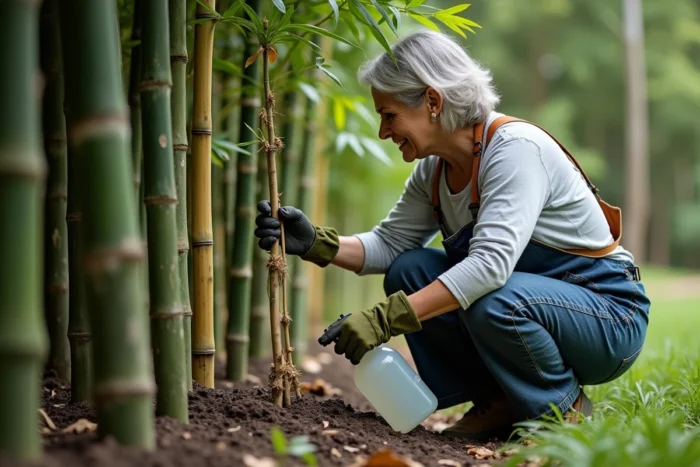
Bleach, or sodium hypochlorite, is a biocide that destroys microorganisms through oxidation. When applied to a plant, it causes desiccation of the tissues in direct contact. On bamboo, this action remains superficial: the exposed culms and leaves may brown, but the underground rhizomes, protected by several centimeters of soil, are not affected. Understanding this chemical limit allows for a better assessment of the actual relevance of bleach in relation to bamboo biology.
Bamboo Rhizomes: Why Bleach Cannot Reach Them
Running bamboo spreads through a network of underground rhizomes that extends horizontally, sometimes several dozen centimeters deep. Each rhizome node carries a bud capable of producing a new culm. As long as this network remains intact, the plant will regrow.
Sodium hypochlorite is a powerful oxidizer, but it quickly degrades upon contact with the organic matter in the soil. When poured on the surface or on a cut cane, it loses its activity before migrating to the active rhizomes. Thus, the product acts on the visible aerial part without altering the underground system that supports growth.
Some gardeners attempt to pour concentrated bleach into the hollow canes after a flush cut. The liquid descends into the stem, but the connection between the cane and the rhizome is not an open conduit: the internal partitions of the culm limit diffusion.
The rhizome continues to nourish other buds located at a distance. Before attempting to use bleach against bamboo, one must integrate this botanical reality: the problem is not on the surface, it is underground.
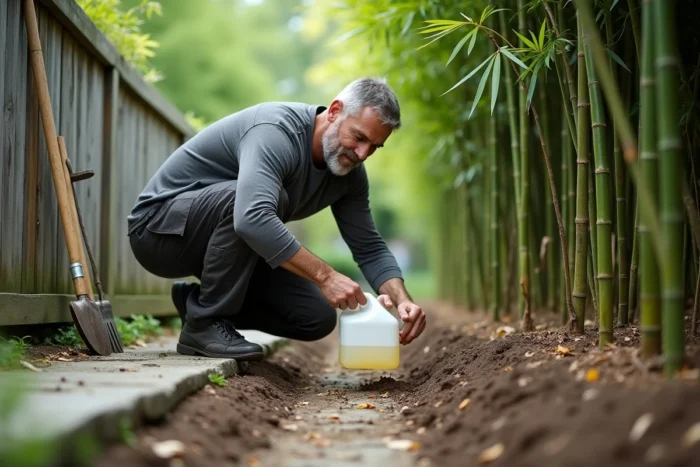
Bleach in the Garden: What French Regulations Say
French regulations strictly govern the products that can be used for weeding. Since the ban on synthetic herbicides for individuals (Labbé law and its implementing texts), only active substances with a marketing authorization (MA) for garden use can serve as herbicides. Sodium hypochlorite does not have this MA.
Using bleach as a herbicide on bamboo is therefore considered a misuse, just like the use of glyphosate or hexazinone by an individual. None of these products are legal in this context.
Beyond the legal framework, the Water Agency and several local authorities have been reminding for a few years that sodium hypochlorite destroys the microbial life of the soil (bacteria, mycorrhizal fungi) and can contaminate surface waters and groundwater, even in small quantities. This is not a technical detail: soil sterilized by bleach becomes hostile to any new planting for an extended period.
Collateral Damage of Bleach on Soil and Neighboring Plants
Sodium hypochlorite does not target bamboo. It oxidizes everything it touches. The consequences extend beyond the treated area.
- Nitrogen-fixing bacteria and decomposer fungi, which ensure the natural fertility of the soil, are destroyed first. The treated soil loses its ability to nourish plants for several months.
- The roots of neighboring plants (shrubs, perennials, grass) absorb the diluted bleach from rainwater or irrigation. Root necrosis appears on plants located sometimes more than a meter from the application area.
- The soil pH increases sharply after application, disrupting the absorption of trace elements by the remaining plants. Deficiencies manifest as yellowing of leaves and stunted growth.
- In case of rain, the product is carried towards storm drains or ditches, contributing to the diffuse pollution of waterways.
A soil impoverished by bleach complicates any subsequent replanting. The gardener who simply wanted to contain bamboo ends up with a sterile area.
Mechanical Methods and Anti-Rhizome Barriers: The Effective Alternatives
Repeated Flush Cutting to Deplete Reserves
Cutting all the canes flush with the ground, systematically repeated as soon as new shoots (turions) appear, gradually deprives the rhizomes of their energy source. Photosynthesis ceases, and underground reserves are depleted. This method requires consistency: every turion that exceeds a few centimeters must be cut. Over several seasons, regular flush cutting weakens the rhizome network until complete exhaustion.
Digging Up Rhizomes with a Pickaxe or Mini-Excavator
For a quicker result, mechanical removal of rhizomes remains the most reliable method. A pickaxe or forked spade is sufficient for a small clump. In a larger area, using a mini-excavator speeds up the work. Every fragment of rhizome left in the ground can regrow: careful sorting of the excavated soil is part of the process.
Anti-Rhizome Barrier as Prevention
The anti-rhizome barrier is a sheet of high-density polyethylene or polypropylene, buried vertically to a sufficient depth around the planting area. It blocks the horizontal progression of rhizomes. A few points of vigilance:
- The barrier must extend a few centimeters above ground level to prevent rhizomes from passing over it.
- The junctions between sheets must be perfectly sealed: insufficient overlap allows rhizomes to pass through, exploiting the slightest flaw.
- An annual inspection of the perimeter allows for the detection of rhizomes attempting to circumvent the barrier from above.
This solution does not eliminate bamboo, but it confines it to a defined area. For gardeners who wish to maintain a bamboo patch without suffering its expansion, this is the most sustainable solution.
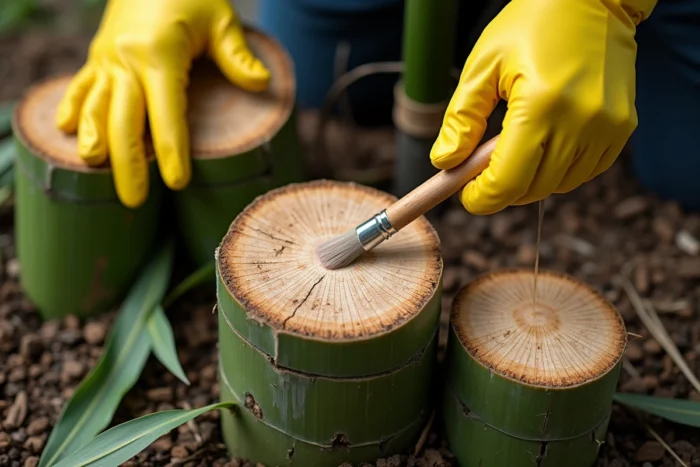
Bleach remains a household product with no real effectiveness on a root system as resilient as that of bamboo. Its use in the garden exposes one to penalties, degrades the soil, and does not resolve the underground problem. Repeated cutting, mechanical removal, and anti-rhizome barriers require more physical effort, but they act where bamboo truly lives: underground.