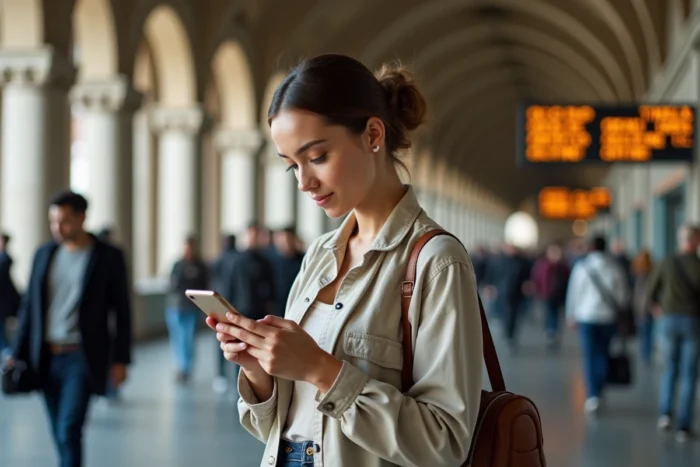
We are at Kyoto station, the information panel is only in Japanese, and the mobile connection is slow. It’s in situations like this that the choice of an instant translation tool makes all the difference. Not in a theoretical comparison, but in front of a counter, a menu, or a safety instruction that we don’t understand.
Oral or written translation while traveling: two uses, two requirements
Asking for directions from a passerby and deciphering a scooter rental contract is not the same exercise. Current tools specialize, and we gain time on knowledge before leaving.
For a spontaneous conversation (market, taxi, restaurant), responsiveness is key. We need a quick, even approximate, voice translation that keeps the pace of the exchange. Smartphone applications like Google Translate or translator earbuds fulfill this role.
For written communication (reservation, email to a landlord, medical notice), the accuracy of the translated text matters more than speed. Here, tools like DeepL produce more natural formulations, especially in French and Spanish. Choosing the best instant translation tool often comes down to identifying which one best covers your dominant use, oral or written, rather than looking for a universal Swiss army knife.
In practice, many regular travelers carry two complementary tools: a voice application for the field and a text translator for sensitive messages.

Offline mode: the criterion everyone forgets before departure
We rarely think about it from our living room with Wi-Fi, but offline mode becomes a decisive criterion as soon as we leave major cities. A bus in the northern mountains of Vietnam, a ferry between two Greek islands, an airport in transit without a local SIM card: these situations are common and predictable.
What offline mode concretely changes
Google Translate allows you to download language packs for use without a network. Offline translation is less accurate than the connected version, but it remains functional for simple phrases: asking for help, understanding directions, reading a sign.
Feedback varies on this point depending on the languages. Packs for European languages (Spanish, Italian, German) yield good results offline. For languages with a structure very different from French (Japanese, Thai, Arabic), quality decreases significantly without a connection.
- Before departure, download the language packs for the countries you will pass through, not just the final destination, but also the stopovers
- Check the size of the pack: some weigh several hundred megabytes and saturate a phone already full of photos
- Test airplane mode at home with a complex sentence to assess the actual quality of the downloaded pack
A tool without a reliable offline mode remains a comfort gadget, not a travel companion.
Translator earbuds and dedicated devices: gadgets or real field tools
Real-time translation earbuds (Timekettle, Google Pixel Buds with Live Translate) promise a natural conversation without holding the phone between two speakers. On paper, it’s appealing. In practice, the reality is more nuanced.
What works well
In a quiet environment (hotel lobby, information desk), translator earbuds deliver on their promise of fluidity. One speaks, the translation arrives in the other person’s ear or in their own. Eye contact is maintained, hands remain free.
What struggles in the field
In a noisy market, a crowded restaurant, or a busy street, voice recognition falters. Ambient noise disrupts capture, and translations become erratic. We end up pulling out the phone and typing the text, exactly what we wanted to avoid.
A dedicated voice translation device is justified for long and repeated trips in countries where the language barrier is strong (Japan, China, Korea). For a short stay in Europe, a free smartphone application largely covers the need.

Photo translation and camera: read a menu or a sign without typing a word
This is probably the most underestimated function for everyday travel. Pointing your camera at text and getting the translation overlaid on the image, directly on the screen, changes the game in three recurring situations.
- Untranslated restaurant menus: we photograph the menu, the translation appears as an overlay, and we order without stress
- Information signs in transportation: schedules, instructions, directions, especially in non-Latin alphabets
- Medication notices purchased on-site: understanding dosage and contraindications before taking anything
Google Translate offers this camera function in real-time, including partially offline for certain languages. Photo translation avoids having to copy characters that we cannot write, which is particularly useful in Chinese, Japanese, or Korean.
Personal data protection and translation tools
We rarely think about it when translating a conversation, but every phrase dictated to a voice translator passes through remote servers. For a request for directions, the stakes are low. For a discussion with a local doctor or an exchange about a financial transaction, the question deserves to be asked.
Major platforms (Google, Microsoft) use translation data to train their models. The terms of use specify this, but few travelers read them. Some tools offer stricter encryption or local data processing, a point to check if you are translating sensitive information.
For everyday conversations while traveling, the risk remains low. For anything related to health, finances, or administrative matters, prefer a tool whose privacy policy is explicit about data storage and reuse.
Choosing a travel translator boils down to three concrete trade-offs: oral or written, connected or offline, free application or dedicated device. Identifying your own field priorities before departure remains the safest way to avoid being mute when you need it most.