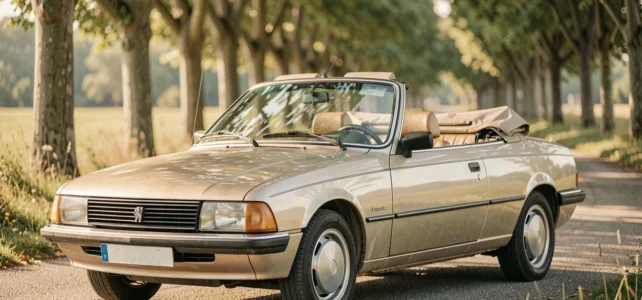
The Peugeot 305 was never included in the official catalog as a convertible. However, a few examples of this open-top model still circulate, the result of artisanal transformations carried out in the 1980s. Comparing these open 305s to French convertibles from the same era highlights what makes this model so unique, and what complicates its acquisition or legalization today.
Peugeot 305 convertible versus French convertibles of the 1980s
No official technical sheet exists for a factory-produced 305 convertible. The few known examples are the result of roof cuts and body reinforcements made by independent coachbuilders. To contextualize these vehicles, a comparison with French convertibles produced in series during the same period sheds light on the differences.
| Model | Production | Engine | Manufacturing Type |
|---|---|---|---|
| Peugeot 305 “convertible” | Artisanal (a few units) | 4-cylinder petrol | Transformation based on sedan |
| Peugeot 504 Cabriolet | Series (Pininfarina) | 4-cylinder petrol / V6 | Factory, Pininfarina body |
| Renault Fuego convertible (project) | Unreleased prototype | 4-cylinder petrol | Styling study |
| Citroën Visa convertible | Very limited (preparers) | 4-cylinder petrol | Artisanal transformation |
The 504 Cabriolet, designed and assembled by Pininfarina, benefited from a structure designed from the outset to run without a roof. The 305 convertible never had this structural advantage. Its rigidity relies entirely on the work of the coachbuilder who cut the roof and welded reinforcements into the chassis and sills.
Among enthusiasts documenting the Peugeot 305 convertible, the same observations often arise: extreme rarity of examples, absence of specific convertible parts, and difficulty in tracing the history of modifications.
Homologation and collector’s registration: regulatory constraints in 2026
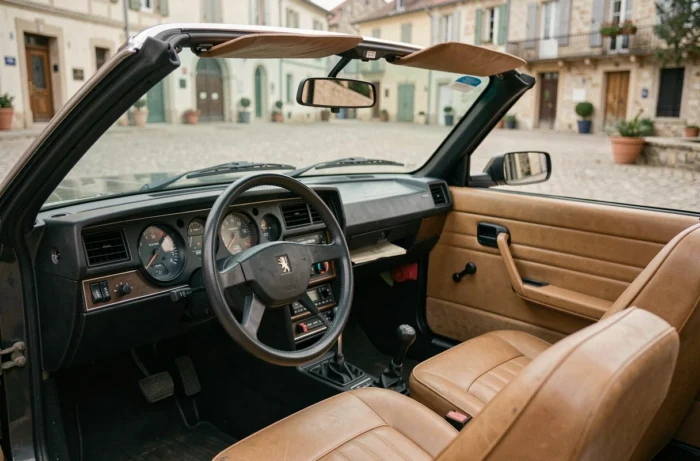
Owning a 305 transformed into a convertible raises an issue that enthusiasts of 305 sedans or station wagons do not encounter. The roof cut constitutes a substantial modification of the body. In France, any modification of this type requires a complete technical file and compliance testing to obtain an isolated approval (RTI).
The process is cumbersome. It requires providing rigidity calculations, proving that the vehicle meets current safety standards, and going through a DREAL service. For a vehicle transformed forty years ago without technical documentation, gathering these elements often proves to be an impossible task.
Collector’s registration and original characteristics
The mention “collector vehicle” on the registration imposes three cumulative conditions:
- The vehicle must be over 30 years old, which all 305s easily meet since production stopped in 1990.
- The model must no longer be produced, a condition also satisfied.
- The technical characteristics must remain unchanged compared to the original model (mechanics, body, structure).
It is on this third point that the 305 convertible falters. A cut roof and welded reinforcements no longer correspond to the characteristics of the original sedan or station wagon. The FFVE certificate (French Federation of Vintage Vehicles), necessary to obtain the collector’s registration, may be refused if the vehicle has significant modifications.
In contrast, a 305 sedan or station wagon in its original state poses no administrative difficulties. The gap between the two situations is radical for a potential buyer.
Market for the Peugeot 305: value and rarity of the artisanal convertible
In the youngtimer and collector car market, the 305 remains generally affordable. Sedans and station wagons in good condition are traded at modest prices compared to other classic Peugeots like the 504 Cabriolet, whose value has significantly increased in recent years.
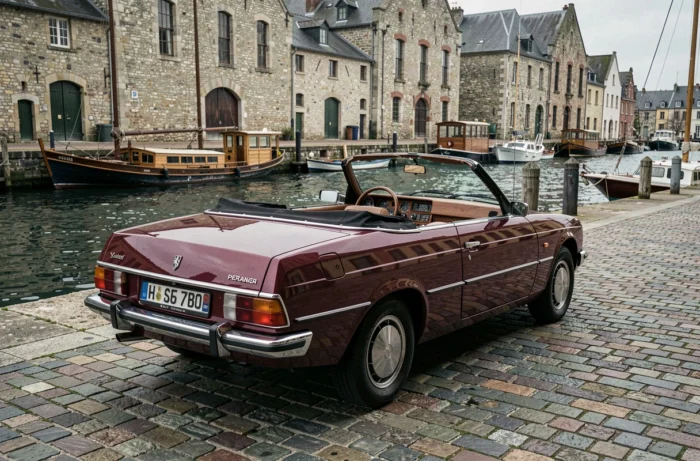
For artisanal open-top versions, rarity does not guarantee a high value. The lack of clear homologation, doubts about the quality of the transformations, and the lack of documentation hinder informed buyers. A collector willing to invest in a complete restoration might be interested, but they must factor in the cost of the RTI file, compliance work, and the search for parts.
Points of caution before purchasing a convertible 305
Some checks distinguish a reasoned purchase from a risky bet:
- The condition of the body reinforcements: visible poor-quality welds indicate shoddy work that compromises rigidity.
- The traceability of the transformation: an identified coachbuilder, invoices, or period photos provide a minimum guarantee.
- The administrative situation: check if the vehicle has a valid registration mentioning the actual body type. A registration labeled “sedan” for a convertible poses a problem during technical inspection.
- The condition of the 4-cylinder petrol engine: the 305 blocks are robust, but forty years of aging require a serious diagnosis (gaskets, cooling system, ignition).
Why the 305 convertible remains a unique collector’s item
Peugeot never marketed a 305 convertible, and the prototypes of alternative bodies (fastback, coupe) documented by L’Argus never progressed beyond the design studio stage. The existing open 305s are therefore unique pieces, each different depending on the coachbuilder who created it.
This uniqueness attracts a specific type of collector: one who seeks the unattainable object rather than market value. The 305 convertible is not a financial investment but a passion project.
The 305 model as a whole suffers from a visibility deficit compared to the 205 GTI or the 504 Cabriolet. Sedans and station wagons are still available at accessible prices, making it easier to enter the world of classic Peugeots. The convertible version, however, requires more patience, administrative budget, and tolerance for technical risk. This is precisely what makes it memorable for those who own it.