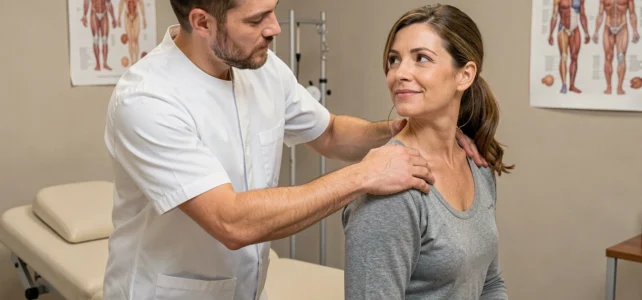
You wake up with pain in your lower back after a weekend of intensive gardening. Should you make an appointment with an osteopath or a physiotherapist? The answer depends less on personal preference than on the exact nature of the problem and what you expect as a result.
Osteopaths’ RPPS number: what changes with registration from 2024
Since October 16, 2024, osteopaths are no longer registered in the ADELI departmental file but in the RPPS (Shared Directory of Professionals in the Health System). Each practitioner now has a unique 11-digit national number, which must appear on their invoices.
This administrative detail has a direct impact on your wallet. Health insurance companies that offer an osteopathy package require this RPPS number to process reimbursements. Before consulting, one can check that an osteopath is properly registered, which guarantees that they hold the protected title and facilitates coverage by complementary health insurance.
Physiotherapists, on the other hand, have been listed in the RPPS for much longer as paramedical health professionals. Their sessions prescribed by a doctor are reimbursed by health insurance, without needing to look for a specific number. This difference in status, as health advice from Santé Boost reminds us, remains the primary sorting criterion for many patients.
Medical prescription or direct access: the care pathway in practice
You can consult an osteopath without a prescription. It is open access, but this also means that the osteopathy session is not covered by Social Security. The cost remains entirely your responsibility, except for mutual insurance packages.

For the physiotherapist, the process is different. In most cases, a prescription from the attending physician is necessary to benefit from reimbursement by health insurance. This prescription specifies the number of sessions and the reason for rehabilitation.
Specifically, here are the situations where the pathway differs:
- After a knee or shoulder operation, the surgeon prescribes reimbursed physiotherapy sessions for functional rehabilitation. The osteopath does not intervene in this protocol.
- For chronic low back pain without an identified cause, one can choose to consult an osteopath directly for a holistic approach, knowing that the session will not be reimbursed by Social Security.
- In the case of respiratory disorders (infant bronchiolitis, post-pneumonia rehabilitation), respiratory physiotherapy is exclusively the domain of the physiotherapist, on medical prescription.
The choice of pathway thus depends as much on the health issue as on your budget and complementary coverage.
Long rehabilitation or one-off session: two treatment logics
A physiotherapist works over time. After an ankle sprain, several rehabilitation sessions are followed, sometimes over several weeks, with exercises for muscle strengthening, proprioception, and joint mobility. The physiotherapist rebuilds an altered function step by step.
The osteopath adopts a different logic. A consultation generally lasts longer (often around an hour), and the goal is to treat the body as a whole in one to three sessions. The manipulations aim to lift mobility restrictions that may be located far from the painful area.
This distinction is crucial for making the right choice. If you need progressive rehabilitation after trauma or surgery, the physiotherapist is the appropriate practitioner. If you feel diffuse tension, mechanical pain without an identified lesion, or a one-off blockage, the osteopath can respond in a few sessions.
When the two disciplines complement each other
Feedback varies on this point, but in practice, many patients combine both approaches. After back rehabilitation with the physiotherapist, an osteopathy session can help rebalance compensatory tensions established during the pain period.
The reverse also works. An osteopath who detects significant muscle weakness can refer to a physiotherapist for a targeted strengthening program.

Concrete criteria for choosing between an osteopath and a physiotherapist
Rather than comparing care philosophies, one can ask three practical questions before picking up the phone:
- Do you have a prescription? If so, the physiotherapist is the logical choice, with reimbursement at stake. Without a prescription and for a one-off mechanical pain, the osteopath can intervene directly.
- Does your problem require rehabilitation over time (post-operative, gradual loss of mobility, respiratory pathology)? This is the physiotherapist’s domain.
- Does your mutual insurance cover osteopathy? Check the number of annual sessions covered and the ceiling per session. Without coverage, the cost can weigh heavily.
The right professional is the one that corresponds to your specific medical situation, not the one a neighbor recommended for a problem different from yours. An attending physician remains the best contact to guide between these two disciplines when doubt persists.
Last precaution: always check that your osteopath has a valid RPPS number and that your physiotherapist is registered with the Order of Physiotherapists. These checks take two minutes and ensure that you are consulting a practitioner whose diploma and training have been verified.