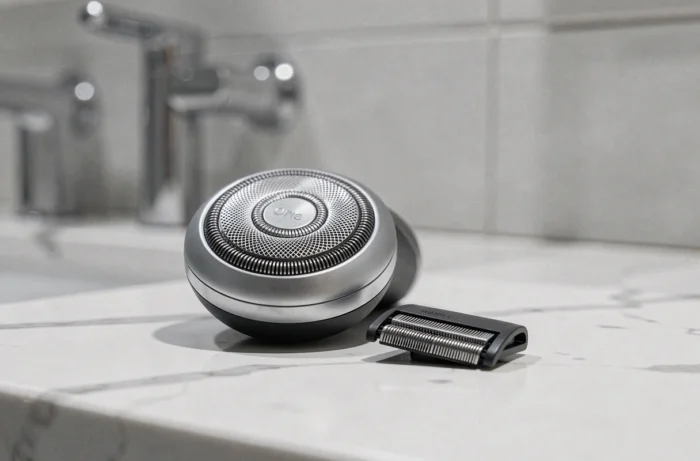
The Philips OneBlade 360 has established itself as a versatile shaving tool, sold with the promise of a pivoting blade that adapts to the contours of the face. The most common question is less about the handle than the blade itself: how long does it last, which models is it compatible with, and does the replacement cost remain reasonable over time?
OneBlade 360 blade vs. classic blade: the technical differences
Philips currently sells four blade families for its OneBlade range. The 360 blade (references QP420, QP430, QP440, QP450, depending on pack size) differs from the classic blade (QP210, QP220, QP230) in that it can pivot in every direction. This flexibility helps it follow the contours of the face more closely without applying pressure.
Two other variants are available: the 1st Shave anti-friction blade (QP215, QP225), designed for sensitive skin, and the Intimate SkinProtect blade (QP219, QP229), which has extra protection for body areas. All four families attach to the handle in the same way, which often causes confusion about actual compatibility.
Online reviews that compile reviews of the Philips OneBlade 360 confirm that the pivoting blade offers a noticeable comfort improvement on the face, but that the difference is less apparent for body grooming, where the skin surface is flatter.
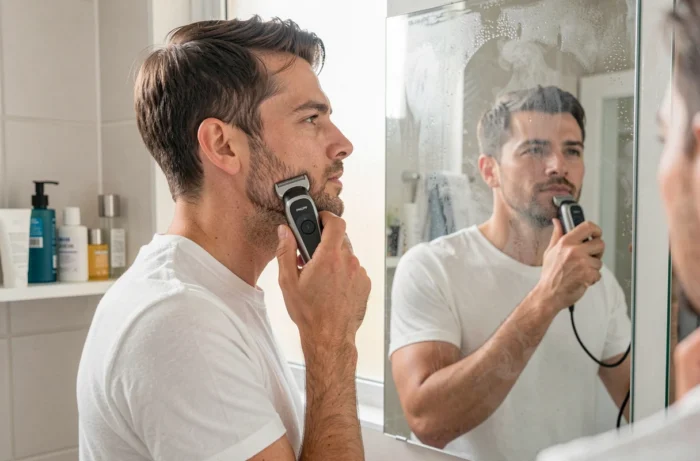
OneBlade 360 blade compatibility: exclusions Philips mentions in the fine print
The phrase “compatible with all OneBlade handles” appears on most 360 blade packaging. In practice, Philips excludes several series from this compatibility: models QP1xxx, QI1xxx, QP651x, QP652x, QP662x and QP6505. These exclusions appear in the technical documentation but rarely on the packaging in stores.
The issue is a real one. Someone with an older OneBlade from the QP1xxx series who buys a pack of 360 blades expecting an upgrade to their shave will find the blades unusable. The only reliable way to check is to find the exact reference engraved on the handle (usually beneath the blade cover) and compare it with Philips’ exclusion list.
Classic and 360 blades: interchangeable or not?
Classic blades remain compatible with newer handles. However, 360 blades do not work with the older excluded handles. Compatibility is therefore not symmetrical: a newer handle accepts both types, while an older handle accepts only classic blades.
This asymmetry can be a problem for users who accumulate several handles over the years. Before buying blades in a multipack, check the model number of each handle to avoid wasting part of the pack.
Real-world lifespan of OneBlade 360 blades: four months is a guideline, not a guarantee
Philips recommends replacing the blade at least every four months. This is an indicative maximum, not a universal threshold. Several factors can significantly shorten its lifespan:
- Shaving frequency: daily use puts much more strain on the blade than shaving twice a week.
- Hair density: a thick beard or coarse hair speeds up wear on the protective coating and cutting edge.
- Care after each use: inadequate rinsing leaves residue that clogs the pivot mechanism and reduces glide.
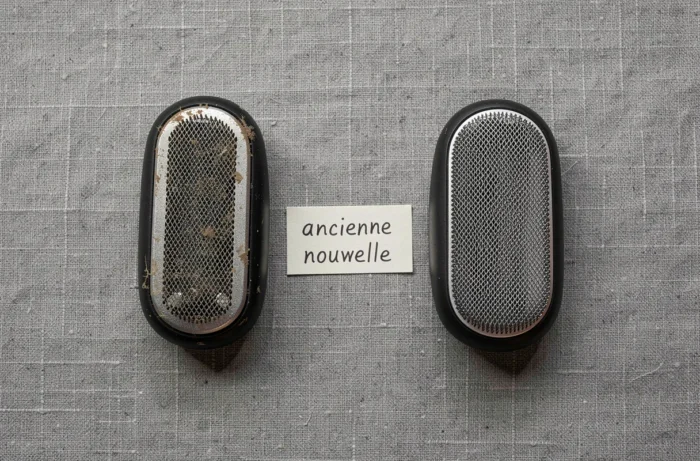
Some 360 blades include a visual replacement indicator: an icon that gradually appears as the blade wears. This provides an additional cue but does not replace the recommended schedule. On models without an indicator, the warning signs are the same as with any shaver: tugging, unusual irritation, or a blade that catches instead of gliding.
Annual maintenance costs and third-party compatible blades: what the data tells us
Replacing the blade every three to four months means using three to four blades a year. Official Philips packs are available in sets of 2, 3, 4 or 5 blades, with the price per blade decreasing as pack size increases.
Compatible blades from third-party manufacturers are sold on online marketplaces at considerably lower prices. Their reliability remains an open question. Philips warns against low-priced counterfeit blades, which can cause irritation and cuts because of a poorly calibrated cutting edge or a non-compliant protective coating.
How to identify a counterfeit blade
Warning signs when shopping online include a price that is unusually low compared with Philips’ price, packaging with no batch number or official Philips reference, and a third-party seller with no significant sales history.
Hygiene and using one blade for both face and body: the often-ignored recommendation
Philips recommends using separate blades for the face and body. This hygiene advice is rarely followed in practice, with many users relying on a single blade for both areas. The 360 blade is officially recommended for the face, while the Original blade is described as suitable for both face and body.
Using the same blade for both areas accelerates wear (more surface area treated per session) and increases the risk of bacterial transfer. For someone who shaves both face and body with a OneBlade, following Philips’ recommendation effectively doubles the annual blade budget.
The key takeaways about OneBlade 360 blades are easy to verify: compatibility depends on the handle’s exact model number, four months is a maximum that real-world use often shortens, and cheap third-party blades raise reliability concerns documented in buyer reviews. Checking your handle’s reference before buying a pack is the most cost-effective step.