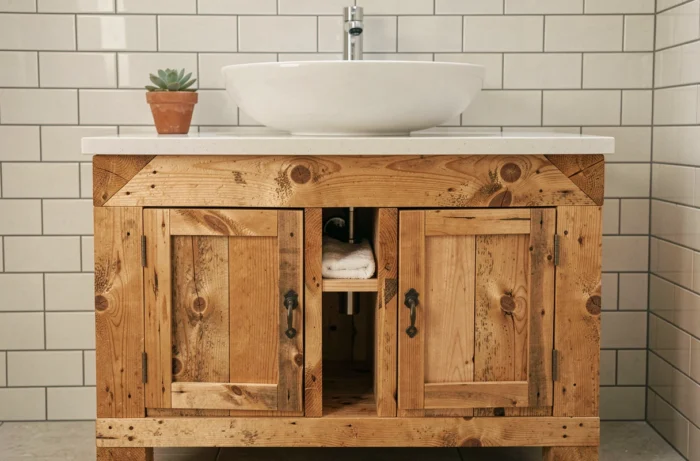
Building a vanity unit from pallets raises a question rarely addressed in tutorials: how to ensure the durability of recycled wood against the constant humidity of a bathroom while ensuring a clean integration with existing plumbing? The choice of wood, surface treatment, and siphon management determine the actual longevity of the project.
Pallet wood in the bathroom: comparison of treatments against humidity
Untreated pallet wood absorbs water quickly. In a bathroom, this characteristic becomes a structural problem within a few months. The choice of treatment determines the longevity of the furniture much more than the quality of the assembly.
| Treatment | Humidity Protection | Final Appearance | Renewal |
|---|---|---|---|
| Marine polyurethane varnish | Very high (waterproof film) | Glossy or satin, masks the grain | Every 2 to 3 years |
| Hard oil (like linseed oil + drier) | Good (deep penetration) | Natural matte, highlights the raw wood | Every year |
| Mat eco-label varnish | Fair (thin film) | Transparent, retains the pallet style | Every 1 to 2 years |
| Water-repellent outdoor stain | High (microporous) | Slightly tinted | Every 2 to 3 years |
Marine varnish offers the best barrier, but it gives a plasticized finish that erases the raw character of the pallet. To maintain the sought-after natural wood aesthetic in modern bathrooms, hard oil remains the best compromise between protection and appearance. It requires more frequent maintenance, which means planning for easy access to all sides of the furniture.
Before any treatment, drying the wood is a step that many DIYers underestimate. Pallets recovered from outdoors often contain too high a moisture content. Several weeks of indoor drying are necessary to avoid warping after assembly. To make a durable pallet vanity unit, this wood preparation phase is as important as the assembly itself.
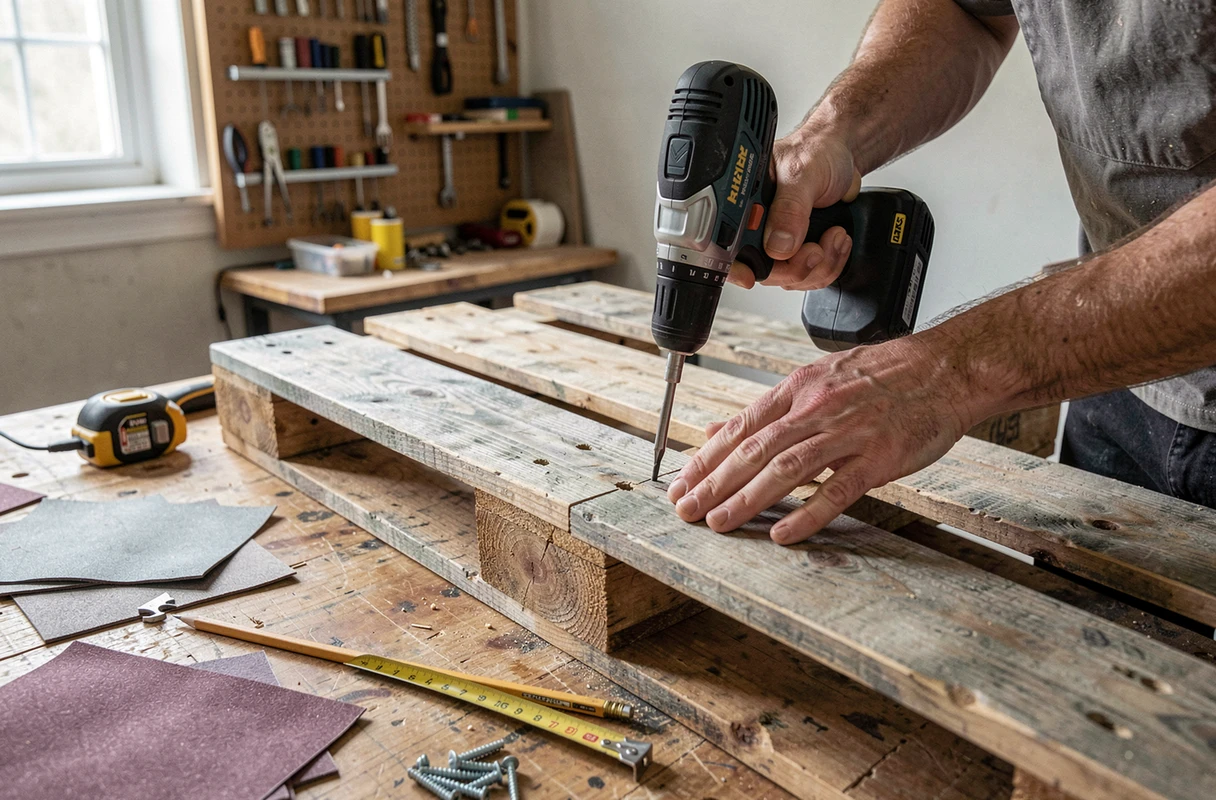
Cutting the siphon passage and plumbing connection
Classic tutorials detail the cutting of boards and the screwing of the frame. They often quickly overlook the technical point that can cause the project to fail: the clean integration of the siphon and water inlets.
The siphon of a countertop basin occupies a variable volume depending on the model. Before cutting the boards for the back or the intermediate shelf, the basin must be dry-fitted, the exact position of the drain must be marked, and the necessary passage must be traced.
- Use a set of hole saws suitable for the diameter of the drain pipe for a clean cut, without splinters on the pallet wood
- Allow a margin of a few centimeters around the siphon to facilitate tightening and potential replacement
- Treat the edges of the cut with the same product as the rest of the furniture, as the wood exposed in this area is in direct contact with water splashes
- Check that the hot and cold water inlets pass without forcing between the frame’s uprights, even if it means adjusting the spacing of the crossbars
A pallet furniture piece has irregular board thicknesses. This irregularity complicates the alignment of the connections. It is better to fix the supply hoses before closing the furniture rather than trying to work blindly once the frame is assembled.
Pallet frame structure: choice between freestanding and wall-mounted furniture
Commercial vanity units are evolving towards wall-mounted formats, fixed to the wall without contact with the floor. This trend meets a practical need: to facilitate cleaning and reduce moisture rise by capillarity. Reproducing this principle with pallet wood is possible, but the constraints differ.
Freestanding furniture
This is the simplest configuration. Four legs cut from pallet beams support the top. The weight of the basin filled with water (several kilograms) rests directly on the floor. Corner brackets screwed at the angles are sufficient to stiffen the whole. The Esprit Cabane tutorial recommends 4 brackets of 30 x 30 mm and 4 x 35 mm screws for this fixation.
Wall-mounted furniture on battens
Fixing a pallet unit to the wall requires ensuring that the partition can support the load. On standard drywall, regular expansion anchors will not be sufficient. It is necessary to target the studs of the framework or use fasteners suitable for heavy loads.
The total weight of the loaded pallet unit far exceeds that of an industrial MDF unit. Pallet wood is denser, and the thickness of the boards (often around 2.5 cm) adds mass. This parameter often guides the choice towards the freestanding version, which is safer without expertise in wall mounting.
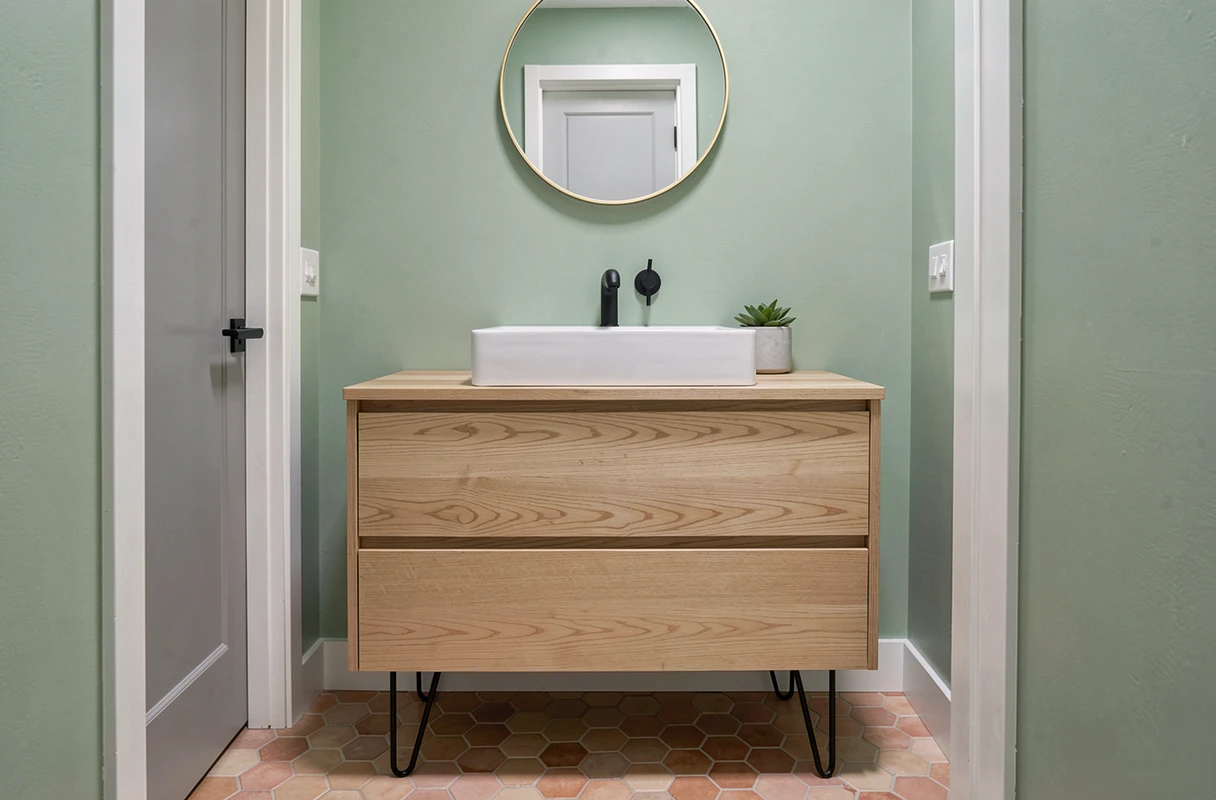
Integrated storage in a pallet unit: drawers or doors
A vanity unit without storage loses a significant part of its utility. The pallet boards, with their thickness variations, make the construction of sliding drawers more complex than with planed wood.
The most realistic solution is to install hinged doors with simple hinges rather than drawers. Two doors cut from pallet slats, fixed with piano hinges or butt hinges, provide access to the inside of the unit. An intermediate shelf (while respecting the siphon passage) allows for product separation.
For drawers, metal slides and perfectly flat fronts are required. Even sanded pallet slats have variations that can jam the slides. If you insist on drawers, plane the fronts to a constant thickness or double them with thin plywood.
- Hinged doors: simple to make, tolerate wood irregularities, direct access to the siphon
- Drawers: better organized storage, but demanding construction with reclaimed wood
- Open shelf with curtain: intermediate solution that masks the contents without adjustment constraints
The standard width of a pallet (about 100 cm) corresponds to a comfortable single basin unit. For a double basin, it is necessary to assemble slats from two pallets, which extends the manufacturing time and multiplies the joints to be treated against humidity.
A successful pallet unit combines rigorous waterproof treatment, precise plumbing cutting, and a storage system adapted to the irregularities of the wood. Any compromise on one of these three points will pay off in durability or practicality in the months following installation.