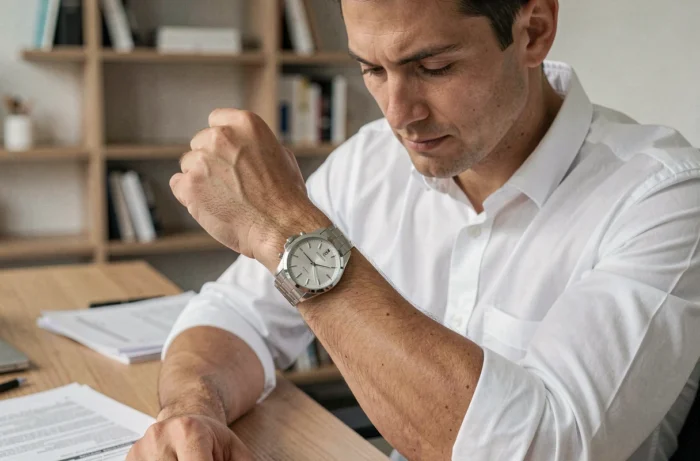
Wearing your watch with the dial facing inward on the wrist remains a minority gesture, but it is far from trivial. Long associated with military and special forces, this so-called “reverse” wear is gaining traction among civilians, largely due to smartwatches. The phenomenon deserves closer examination than the usual shortcuts regarding discretion or style.
Health sensors and the inner wrist: how smartwatches change the game
Classic mechanical watches function regardless of their positioning on the wrist. Their movement does not require specific skin contact. With smartwatches, the situation is different: optical heart rate and oximetry sensors depend directly on the contact between the back of the case and the skin.
Manufacturers recommend a snug yet comfortable fit, about a finger’s width above the wrist bone. Turning the dial inward naturally presses the sensor against an area where blood vessels are closer to the surface. This positioning can improve the reliability of measurements, especially during physical exertion when arm movements can cause micro-lifts of the strap.
It is then understandable why wearing your watch upside down according to Rev Mode attracts so many readers: the issue goes beyond mere dress code as soon as a health device is involved. Wearing a smartwatch upside down is not an aesthetic choice; it is a functional adjustment that can influence the quality of the data collected.
Results vary from user to user. Some report more stable measurements with the dial facing inward, while others notice no difference. Reliability depends on the sensor model and the type of strap, not just the orientation of the case.
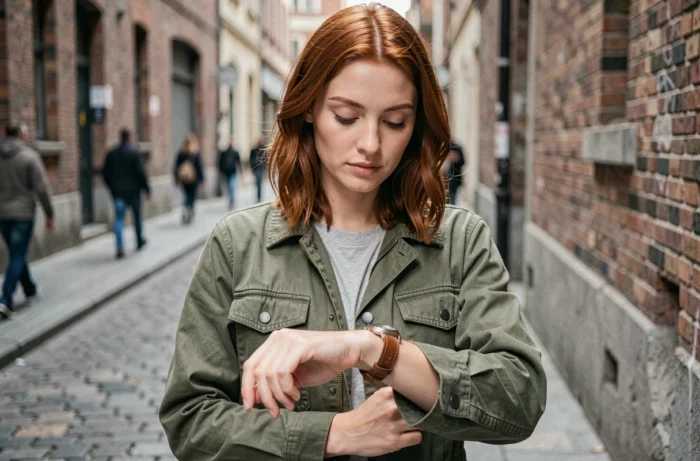
Watch worn upside down: the tactical heritage behind the gesture
Wearing the dial facing inward on the wrist comes directly from military practices. The reasons are known but rarely detailed precisely.
- Elimination of glare: a watch face oriented outward can catch sunlight and betray a position. Shooters and special units wear the dial inward to eliminate this risk, especially in open environments or during night operations with vision goggles.
- Protection of the dial: facing the wrist, the glass is less exposed to shocks, friction against equipment, weapons, or terrain. For personnel who crawl, climb, or handle heavy equipment, this is a direct precaution against breakage.
- Quick reading without visible movement: checking the time by simply turning the wrist towards oneself, without raising the arm or rotating the forearm, reduces noticeable movements from a distance. A detail in tactical situations.
This wear is not universal in the military. Many soldiers wear their watches in a classic manner, and the practice varies by units, theaters of operation, and individual preferences. The idea of a “military standard” for wearing it upside down is partly a myth perpetuated by popular culture.
Discretion in daily life and professional codes
Outside the military context, wearing the watch inward meets a need for discretion that is often underestimated. Checking your watch in a meeting without the gesture being perceived as rude is a common motivation among executives, doctors, or lawyers. The movement is shorter, less demonstrative.
This discretion also works the other way. Some people prefer not to expose an expensive model in environments where it might attract attention. The dial turned towards the wrist conceals the brand, design, and bezel. This is not paranoia; it is a pragmatic choice in specific urban or professional contexts.
On the other hand, wearing it reversed as a “style signal” remains marginal. Contrary to what some content suggests, there is no structured fashion trend around this gesture. Wearing it upside down remains primarily utilitarian, not decorative.
Skin risks of continuous wear: the phenomenon of watch rot
One aspect rarely addressed in articles about wearing watches concerns the dermatological consequences. Dermatologists warn about “watch rot,” a phenomenon of skin maceration caused by the continuous wearing of a watch, particularly a smartwatch.
Trapped sweat under the strap promotes irritation and dermatitis. The problem worsens when the watch is worn continuously for health tracking (sleep, continuous heart rate). Wearing the dial facing inward does not fundamentally change this risk, but it shifts the main contact area of the case to a part of the wrist where the skin is often thinner and more sensitive.
For wearers who alternate between the inside and outside of the wrist, changing position at least allows for varying pressure and friction areas. This is a practical argument rather than a remedy.

Mechanical or smart watch: wearing it upside down has different implications
The distinction is rarely made clear. With a mechanical watch, turning the dial inward does not change the functioning of the movement. The caliber, whether it is a chronograph or a tourbillon, continues to operate independently of orientation. Gravity affects mechanical movements, but the position “dial facing the wrist” is neither more nor less restrictive than classic wear for most modern calibers.
With a smartwatch, wearing it reversed alters the interaction with the device. The touchscreen becomes less accessible for quick navigation, notifications are harder to read discreetly, and some models automatically adjust the display orientation. The gain in health sensors comes at the cost of reduced ergonomics for digital functions.
This compromise explains why the majority of smartwatch users end up returning to classic wear after a few weeks of trial. The available data does not allow for a conclusion that one positioning is objectively superior to the other for all uses.
Wearing the watch towards the inside of the wrist is neither a passing trend nor a universal standard. It is an adjustment that responds to specific constraints: sensors, glare, discretion, case protection. Each use imposes its own positioning, depending on whether the watch is used for measuring or informing.