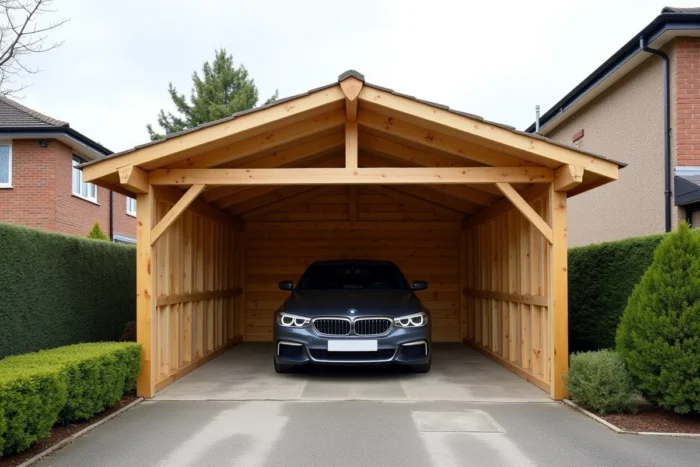
A wooden carport, often referred to as a carport, is an open structure made up of supporting posts and a roof, designed to protect a vehicle from the elements without the constraints of a closed garage. Finding a model that combines quality craftsmanship and reasonable pricing requires understanding a few technical parameters before comparing offers.
Wood class and autoclave treatment: the criterion that determines durability
The price of a wooden carport varies little at purchase between untreated wood and treated wood. The difference lies in longevity. A carport exposed continuously to rain, frost, and UV rays requires at least a wood classified III or IV for outdoor use, capable of withstanding prolonged moisture without rotting.
Autoclave treatment involves impregnating the wood under pressure with a fungicidal and insecticidal product. This process significantly extends the lifespan of the structure compared to simply stained wood. When a retailer displays a very low price, the first thing to check is the treatment class of the wood offered.
Resinous species (pine, spruce) dominate the market for kit carports. They offer a good mechanical strength-to-price ratio, provided they are treated. Conversely, larch or Douglas fir withstand the outdoors better without treatment, but their initial cost is higher. For a tight budget, a class IV autoclave-treated pine remains the best quality-price compromise.
To explore the ranges available at DIY superstores, some distributors offer an affordable wooden carport at Brico Dépôt with ready-to-assemble treated pine structures.
Kit carport: what the catalog price doesn’t always reveal
Most wooden carports sold to individuals are delivered in kit form. The displayed price covers the supporting structure (posts, beams, rafters) and sometimes the roof covering. Several items often remain the buyer’s responsibility.
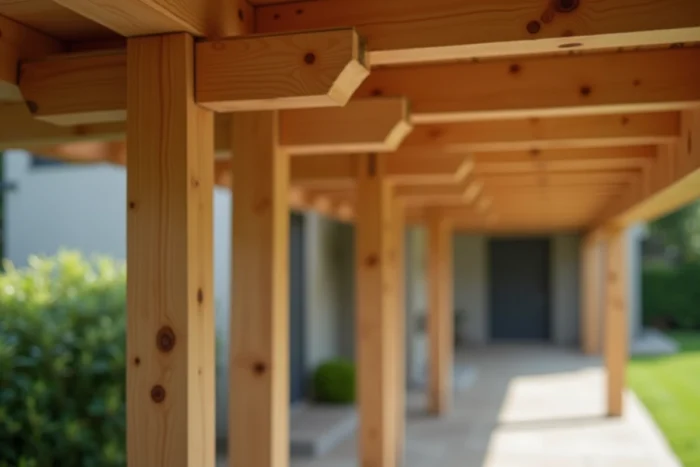
- Ground anchors (plates, metal shoes, concrete blocks) are not always included. Their absence in the kit can represent a significant additional cost, especially on soft ground requiring foundations.
- The roof covering, when not provided, must be purchased separately: bitumen shingles, corrugated sheets, tiles, or steel trays depending on the desired design and local urban planning regulations.
- The stainless or galvanized screws suitable for outdoor use are sometimes delivered in insufficient quantities. Planning for a supplement avoids trips to the store on the day of assembly.
Comparing two carports solely on the kit price is misleading. The actual cost includes anchors, covering, and suitable screws. A seemingly more expensive but complete kit can sometimes be cheaper than a basic kit to which everything must be added.
Development tax and urban planning permission: the hidden cost of a carport
Before ordering, the administrative question deserves as much attention as the choice of wood. A carport, even open, creates ground coverage. The area determines the applicable authorization regime.
For ground coverage between 5 and 20 m², a prior declaration of works is sufficient in most municipalities. Beyond 20 m², a building permit is required, with a heavier file and longer processing times.
What commercial websites rarely mention: outdoor parking areas are subject to development tax. Since 2026, the minimum flat rate is set at 2,928 euros per space, and can reach 5,857 euros depending on the local authority. This tax, calculated based on the urban planning authorization, can double the actual cost of a carport advertised at a low price.
Check with your town hall before purchasing. A simple call to the urban planning department can provide the municipal rate and integrate this expense into the overall budget.
Wooden carport: comparing offers between specialized retailers and superstores
Two distribution channels share the market for wooden carports for individuals. DIY superstores (Brico Dépôt, Castorama, Leroy Merlin) offer standardized kits at competitive prices, often in treated pine. Their advantage: a low entry price, immediate availability, and the ability to see the product in-store.
Specialized retailers in garden sheds and carports (France Abris, Abris Jardin Azur, Chalet de Jardin) offer a broader catalog, with custom options: choice of species, custom dimensions, double-pitched or flat roof, integrated storage shed. Prices are generally higher, but the level of finish and the thickness of the wood sections are also better.
For a simple carport intended for a single vehicle, superstore kits cover most needs. The design remains basic, and the wood sections are calibrated to the minimum structural requirements. For a double carport or a structure that needs to integrate into existing architecture, specialists offer more suitable solutions.
Quick comparison criteria between two quotes
- The section of the supporting posts: thin posts limit resistance to wind and snow load. Check that the dimensions meet the climatic requirements of your region.
- The thickness of the rafters and the clear span: a wide carport with thin rafters will require a central post, which hinders vehicle maneuvering.
- The manufacturer’s warranty against rotting: some manufacturers guarantee the structure for ten years or more, a sign of serious wood treatment.
A quality wooden carport at a low price exists, provided you do not limit yourself to the amount displayed on the label. The wood treatment class, the actual content of the kit, the local development tax, and the structural sections form a whole that only a complete comparison can evaluate. The lowest price is almost never the lowest cost.