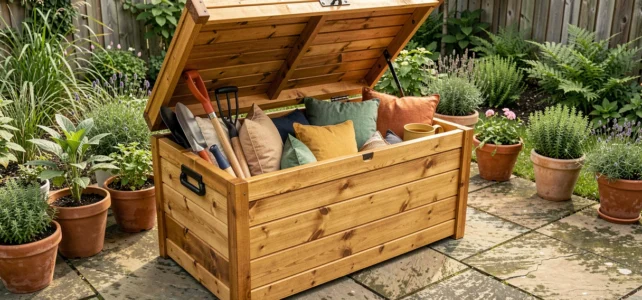
The garden storage box remains one of the most common purchases for organizing an outdoor space, and Brico Dépôt is among the stores where the selection is regularly updated. The choice seems simple at first glance, but several technical, regulatory, and practical parameters deserve examination before heading to the checkout.
Garden Storage Box and Urban Planning: A Often Ignored Constraint
Most buying guides focus on the material or capacity. They overlook an aspect that can make a purchase problematic: local urban planning regulations.
In France, a closed and covered garden storage box can fall under the scope of the development tax and may require an urban planning declaration as soon as it exceeds certain surface area and height thresholds. Beyond 5 m² of taxable surface area, liability generally becomes possible, with formalities varying depending on the context.
The PLU (local urban planning plan) of your municipality may impose constraints on the permitted materials, distances to property boundaries, height, or even the slope of a potential rigid lid. Before choosing a Brico Dépôt garden storage box of substantial volume, checking these rules with your town hall can prevent an unpleasant surprise after installation.
Field reports vary on this point: some homeowners install large boxes without any procedures, while others receive a notice of violation from the urban planning department. Caution suggests that any box exceeding a certain footprint should at least be verified administratively.
Resin, Wood, or Metal: Which Material for an Outdoor Storage Box
The material determines the durability, maintenance, and visual integration of the box in your outdoor space. At Brico Dépôt and elsewhere, three families dominate the market.
Resin Garden Storage Box
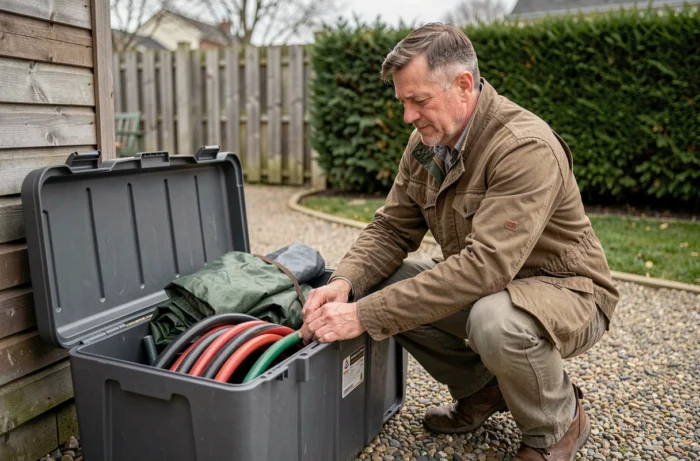
Resin (polypropylene) represents the majority of models available in large DIY stores. Its main selling point: nearly no maintenance. Recent models include UV treatment designed to limit yellowing and weakening from sun exposure.
However, resin ages differently depending on exposure. A box placed full south without shade will degrade more quickly than a sheltered model. The lightweight nature of resin makes it easy to move but can pose a stability issue in strong winds if the box is empty.
Wooden Box
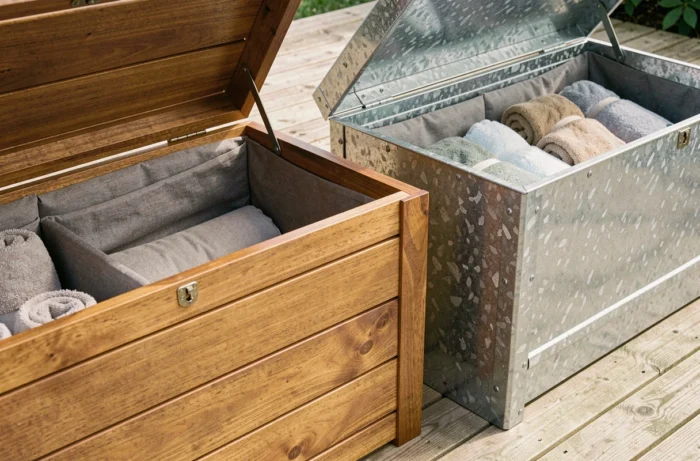
Wood offers an aesthetic that resin cannot replicate. In return, it requires regular treatment (stain, saturator) to withstand moisture and insects. The wood types vary from model to model, and not all have the same natural resistance.
Metal Box
Metal (usually galvanized steel) provides robustness and security. It is more resistant to break-in attempts than a resin box. The main risk remains corrosion if the coating is damaged. Metal condenses moisture in cold weather, which can affect the stored contents without proper ventilation.
Waterproofing and Ventilation: The Two Technical Criteria to Check in Store
A garden storage box serves its purpose only if it protects its contents from the elements. Waterproofing is the criterion most often highlighted by manufacturers, but ventilation is equally crucial.
- Waterproofing depends on the quality of the seals, the design of the lid (domed vs. flat), and the locking system. A flat lid retains rainwater and eventually infiltrates the box at the joints.
- Ventilation prevents internal condensation, which causes mold and odors. Some models include discreet side vents, while others do not. In the absence of ventilation, storing garden lounge cushions or textiles exposes them to moisture.
- The gas spring or the lid support system also deserves verification: a hydraulic spring facilitates access to the contents and prevents the lid from falling, which is particularly useful for large-capacity boxes.
Testing the opening and closing in-store remains the most reliable way to evaluate these aspects. Online product sheets do not always mention the presence or absence of ventilation.
Capacity and Location: Adapting the Box to the Available Space
The capacity expressed in liters gives an indication, but it is not enough to guarantee that the box will meet your needs. A large-capacity box that is too deep makes accessing items at the bottom difficult. Conversely, a wide and shallow model occupies more floor space.
Before purchasing, listing what you plan to store allows for proper sizing of the box:
- Garden lounge cushions and outdoor tablecloths: a generous volume is necessary, but waterproofing and ventilation take precedence over raw capacity.
- Gardening tools (pruners, gloves, small equipment): a compact box is sufficient, provided it is accessible without moving all the contents.
- Children’s toys or pool equipment: prefer a box with a wide opening for quick and frequent access.
The location also influences the choice of material. A box placed directly on a damp lawn will experience more moisture rise than a box installed on a terrace or slab. Some models have an elevated floor that limits this issue.
Price and Availability of Brico Dépôt Boxes: What the Range Reflects
Brico Dépôt positions its offer on an accessible quality-price ratio, with a predominance of resin models. The Keter brand is among the regularly available references in the store’s aisles, alongside private label brands.
Price differences between two boxes of similar capacity are mainly explained by the material, the locking system (integrated padlock or not), the presence of a hydraulic spring, and the quality of the surface treatment. A low price does not necessarily indicate a poor product, but it is essential to check the technical points mentioned earlier before comparing solely on price.
Availability varies by store and season. The most in-demand models (resin, medium capacity) sell out quickly in spring. Checking online stock before heading out can prevent an unnecessary trip.
Choosing a garden storage box commits you for several seasons. A model suited to local regulations, the climate of your region, and what you actually plan to store will fulfill its function without requiring premature replacement. The material and waterproofing remain the two main decisions to prioritize, well before color or design.