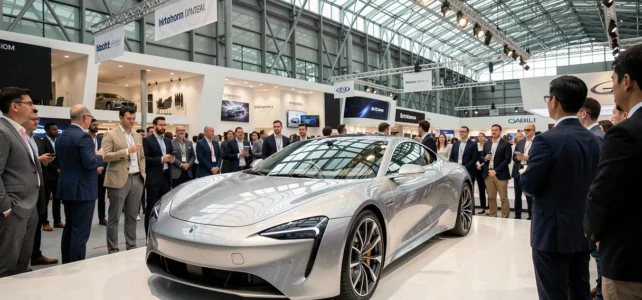
The 2026 Paris Motor Show is not just another auto show. The established alternation with Munich (IAA Mobility) and the gradual fading of Geneva make Paris the European rendezvous of the year for the industry. This 91st edition, scheduled from October 12 to 18 at Paris Expo Porte de Versailles, focuses on issues that far exceed the simple presentation of models.
Alternation with Munich and the disappearance of Geneva: the strategic repositioning of Paris
The biennial alternation system between Paris and Munich now structures the European calendar of auto shows. In odd years, IAA Mobility captures attention. In even years, it’s the Mondial de l’Auto that takes over. Geneva, historically the third pillar, no longer weighs in the equation.
This mechanism has a direct effect: Paris 2026 becomes the only major European show of the year. Manufacturers wanting to reach the continental market have no equivalent alternative in terms of attendance and media coverage. The 2024 edition attracted 508,007 visitors in six days, mobilized over 4,000 journalists, and brought together 48 manufacturers.
We observe that the dates for the Mondial de l’Auto in Paris fall in mid-October, a slot that avoids collision with the Asian shows at the end of the year and gives brands time to prepare their European launches.
The 2026 edition announces nearly 70,000 m² of indoor exhibition space and 15,000 m² outdoors, spread across five halls. This area exceeds what Munich offered in 2023, where a significant part of the event took place outdoors in the city center, with more dispersed logistics.
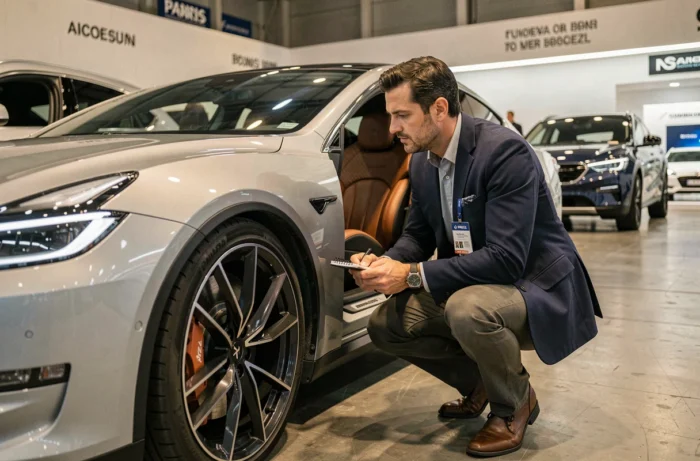
European manufacturers facing the Chinese offensive: the geopolitical dimension of Mondial 2026
The 2024 Mondial de l’Auto had already highlighted the rise of Chinese brands on European soil. The 2026 edition pushes this logic further. According to the ANSA agency, the show is explicitly designed as a response from the European industry to the Chinese offensive, aiming to surpass the 508,000 visitor mark to establish itself as the most attended show in Europe.
BYD, Denza, and other Chinese players are among the confirmed exhibitors. In contrast, Renault Group, Stellantis, Volkswagen Group France, Mercedes-Benz, and BMW Group are showcasing their presence. The Mondial 2026 acts as a direct confrontation ground between two industrial visions: that of historic manufacturers transitioning to electric and that of new Chinese entrants positioned on aggressive pricing.
This tension is not felt with the same intensity in Munich, where the “show + open city” format dilutes the confrontation effect between stands. In Paris, the concentration in the halls of Porte de Versailles forces a physical comparison, stand against stand.
Notable absences at the Mondial de l’Auto 2026: BMW, Nissan, Toyota
A show is also read by its absentees. BMW, Nissan, and Toyota will not be at Mondial 2026, even though these three manufacturers have major new products to present. Automobile Magazine highlights the paradox: brands with recent or imminent launches choose not to exhibit in Paris.
Several hypotheses are circulating in the industry:
- The cost of a stand at the Mondial remains high, and some manufacturers prefer to invest in proprietary events or targeted digital launches.
- The Paris-Munich alternation forces brands to make choices: exhibiting every year at a major European show represents a substantial budget, especially for those also participating in Asian shows.
- Toyota and BMW prioritize CES in Las Vegas and tech-first formats that better align with their communication on software-defined vehicles (SDV).
These absences do not diminish the significance of the show, but they confirm that the Mondial no longer holds a monopoly on visibility. Manufacturers segment their communications according to their target audiences.
AI conferences and software-defined vehicles: the Mondial beyond the showroom
The conference program for Mondial 2026 marks a break from the traditional auto show format. Two themes structure the announced round tables: artificial intelligence applied to driving and European industrial competitiveness in the era of SDV (Software-Defined Vehicle).
The conference titled “The New Frontier of Automobiles: AI, SDV, and Global Competition” positions the show in a territory usually occupied by CES or Mobile World Congress. This shift is not trivial. It reflects the organizers’ (PFA, Hopscotch) desire to transform the Mondial into a platform for sectoral reflection, not just a showcase for car bodies.
For industry professionals, this conference aspect represents a compelling reason to attend that competing shows struggle to replicate. Munich focuses on urban experience, Geneva has disappeared from the radar. Paris combines physical exhibition and strategic content aimed at decision-makers.
2026 Motor Show: what the Paris format retains as a structural advantage
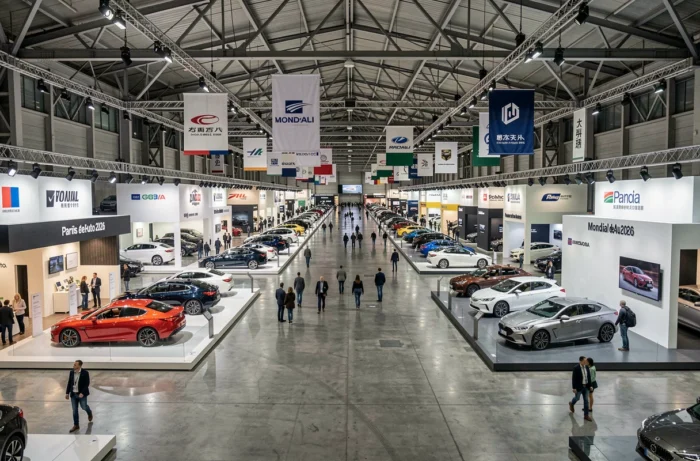
The Mondial de l’Auto remains the only major European show to concentrate its entire offering in a closed exhibition park. This choice has concrete consequences on the visitor experience and the commercial logic of exhibitors.
- The circulation between the halls allows for direct comparison of models, without crossing a city or taking shuttles as in Munich.
- The indoor format ensures stable attendance regardless of the weather, a significant factor for an October event.
- The 158 exhibitors of 2024 included not only manufacturers but also equipment suppliers, mobility players, and startups, broadening the spectrum beyond traditional automobiles.
The 2026 edition already announces more manufacturers present than in 2024. The confirmed return of brands like Ford, Honda, Volvo Cars, Hyundai, and Kia strengthens the density of the offering. The Mondial does not need to reinvent its format: its strength lies in geographical concentration and the critical mass of visitors that no other European event can contest this year.