
The Confort Line WCF-03S falls into the category of air coolers that combine ventilation, misting, and humidification. With a stated power of 90 watts and three fan speeds, this device occupies a precise technical niche between a classic fan and a portable air conditioner, two product families with very different consumption profiles.
Power of 90 W of the WCF-03S: what it changes on the electricity bill
A table or standing fan typically consumes between 20 and 60 W. A portable air conditioner, on the other hand, operates around 800 to 1,500 W, which is up to 30 times more than a standard fan. The WCF-03S, with its 90 W, positions itself just above the high end of a classic fan’s range.
When running continuously over an eight-hour night, the difference is tangible. A 90 W device moderately engages the meter compared to a mobile air conditioner, which, even in eco mode, remains power-hungry. The cost of use remains comparable to that of a fan, while providing a superior feeling of coolness thanks to the misting.
We recommend checking the Confort Line fan on rafraichisseurdair.com to verify the detailed specifications before purchase, particularly the tank capacity and the exact dimensions of the device.
This intermediate positioning explains why this type of cooler is gaining ground against portable air conditioners in homes where the installation of a fixed split system is not feasible.

Tank and misting: technical limits to know
The misting function of the WCF-03S relies on an integrated water tank. The principle is simple: water is vaporized into fine droplets in the airflow, which lowers the perceived temperature by a few degrees. However, misting increases the ambient humidity level.
In a room that is already humid (open adjoining bathroom, poorly ventilated ground floor), this effect can become counterproductive. The perceived thermal comfort depends as much on humidity as on dry temperature. Beyond 65% relative humidity, the feeling of dampness outweighs the coolness.
Tank maintenance against bacterial risk
Any device with stagnant water requires regular cleaning. The tank should be emptied and dried between prolonged uses. A rinse with white vinegar every two weeks limits biofilm formation.
- Empty the tank after each prolonged misting session to avoid stagnation
- Clean the misting nozzles with a soft cloth, without aggressive detergent that could damage the seals
- Use tap water rather than demineralized water, except in very hard water areas where a 50/50 mix reduces deposits
These actions take a few minutes but are crucial for the device’s durability and the quality of the air it distributes.
Three speeds and remote control: room-by-room use
The WCF-03S offers three ventilation levels. The low speed is suitable for nighttime use in the bedroom, where ambient noise should remain discreet. The high speed is more suited for the living room during the day when the volume of air to be circulated is greater.
The remote control allows you to operate the device without getting up, which may seem trivial but truly changes the experience in the bedroom. Adjusting the speed or turning off the misting in the middle of the night without leaving the bed helps avoid disrupting the sleep cycle.
Covered area and suitable placement
A 90 W cooler does not have the reach of an air conditioner. Its effectiveness is concentrated within a few meters around the device. For a large living room, placing it facing the seating area yields better results than positioning it in a corner.
- In the bedroom, place the device at bed height, avoiding direct airflow on the face (risk of drying out mucous membranes despite misting)
- In the living room, prefer an unobstructed location so that the airflow does not hit a piece of furniture
- Avoid placing it near electronic devices sensitive to humidity (laptop, console)
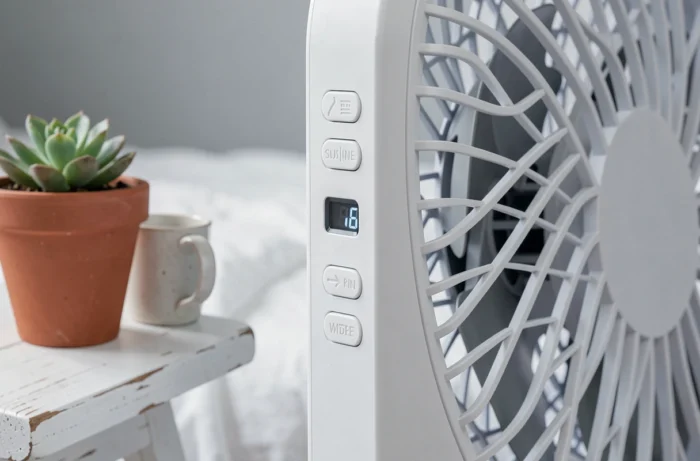
Misting fan or portable air conditioner: rational arbitration
The cooler does not lower the actual temperature of a room. It lowers the perceived temperature through evaporation. This technical distinction is fundamental. A portable air conditioner actually extracts heat from the indoor air and expels it outside via a duct. The WCF-03S, on the other hand, only works on the perceived sensation.
For a studio or a properly insulated bedroom, this approach is often sufficient to make nights bearable during heat peaks. For an apartment under the roof exposed to the south, where indoor temperatures regularly exceed comfort thresholds, only a compression system (portable or fixed air conditioning) will provide effective cooling.
The choice therefore depends on the housing profile. A cooler is suitable for occasional episodes of high heat, not for a heatwave lasting several weeks. In the latter case, we often observe that users end up complementing their equipment with a more powerful solution.
The WCF-03S remains a relevant device for those seeking a compromise between controlled electricity consumption and immediate comfort gain. Its compact format, remote control, and three speeds make it a versatile tool for moderately sized living spaces, provided that the maintenance constraints of the tank are respected and that it is not expected to deliver what only an air conditioner can offer.