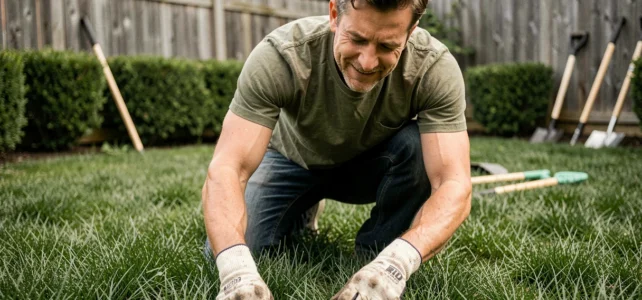
Achieving a dense and green lawn over twelve months requires dealing with constraints that most guides overlook. Summer watering restrictions, the ban on synthetic chemical herbicides for individuals, and the variability of soils from one plot to another: the perfect lawn is less about horticultural dreams and more about a constant technical balancing act between climate, regulations, and the type of seeds chosen.
Water Restrictions in Summer: Is the Perfect Lawn All Year Round Still Realistic?
The summer of 2026 reminded us of a reality that seed catalogs rarely mention. According to the official VigiEau tool, 84 departments had at least one municipality subject to water usage restrictions by early August 2026. Watering lawns is among the first uses limited or prohibited as soon as drought alerts are triggered.
In Ille-et-Vilaine, a prefectural order imposed a ban on watering lawns between 8 a.m. and 8 p.m., followed by an almost total ban at the “crisis” level. Similar measures can be found in many departments in the Center, West, and South.
These restrictions change the game for anyone aiming for a uniformly green lawn from January to December. For several weeks in summer, it becomes materially impossible to compensate for evaporation. Classic varieties of English ryegrass, which are water-hungry, inevitably turn yellow. Field reports vary on this point: some gardeners observe a quick recovery with the first rains of September, while others report areas that remain damaged after a prolonged dry summer.
For guides recommending generous and daily watering, the advice has become partly obsolete in most metropolitan departments during the summer period.
Choosing Grass Seeds and Adapting to Soil
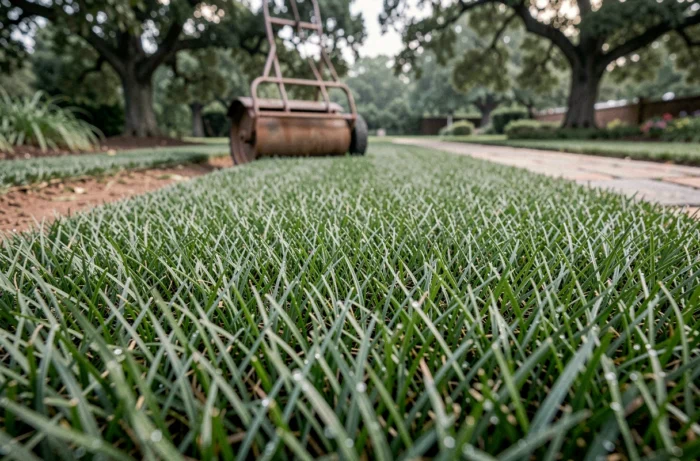
Rather than seeking the miracle variety, it is better to reason by use and local constraints. Mixtures labeled “rustic lawn” include tall fescue and creeping red fescue, which are more drought-tolerant than pure ryegrass. A mixture oriented towards “sports and play” prioritizes resistance to trampling, at the cost of a higher water requirement.
The soil plays as much of a role as the seed. Clay soil retains moisture but compacts quickly, which hinders rooting. Sandy soil drains quickly and requires more frequent fertilizer applications. Before any sowing, it is advisable to observe the texture of the soil at a depth of at least fifteen centimeters. Incorporating compost or an organic amendment improves the structure in both cases.
Product sheets often indicate a seeding rate per square meter. Adhering to this dosage avoids two symmetrical pitfalls: too few seeds leave bare areas quickly colonized by weeds, while too many seeds create competition among seedlings that weakens the population. Detailed resources on the Graine de Jardinier website allow for comparing the characteristics of the main mixtures available in France.
Weeding the Lawn Without Chemicals: What the Regulations Say
Since the Labbé law and its extensions, individuals can no longer buy or use synthetic chemical herbicides to maintain their lawns. Glyphosate, selective lawn herbicides based on 2,4-D or dicamba: all are reserved for agricultural professionals under strict conditions, or are purely prohibited for domestic use.
The authorized alternatives are slower and less radical:
- Manual weeding (weeding knife, root puller, hoe) remains the most reliable method for tap-rooted weeds like dandelions or plantains. The uprooting must be complete, including the root, or rapid regrowth will occur.
- Thermal weeding (flame or steam) destroys the aerial part of unwanted grasses. Its effectiveness on rhizomatous perennials (couch grass, bindweed) remains limited: several passes are necessary to exhaust the underground reserves.
- Approved biocontrol products (pelargonic acid, concentrated acetic acid) act by foliar contact. They are not selective: they also burn the lawn if misapplied.
Household white vinegar is often presented as a natural herbicide. Available data do not allow for a conclusion on its lasting effectiveness on unwanted grasses, and its use as a herbicide is not approved in France.
Mowing and Seasonal Lawn Maintenance: Frequency and Cutting Height
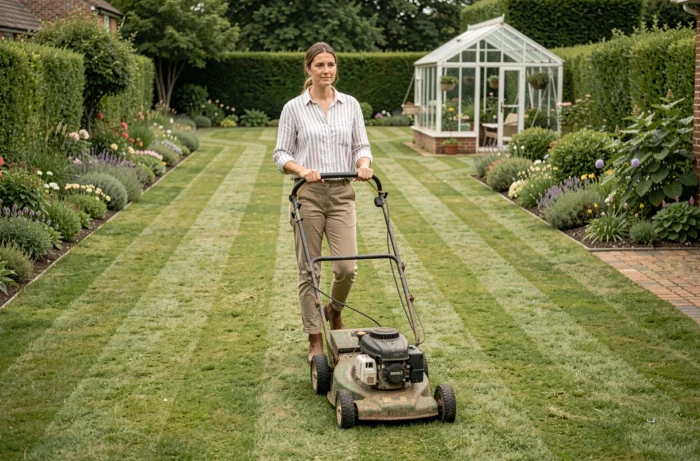
The mowing height affects the health of the lawn much more than the frequency. Mowing too short weakens the root system and encourages the appearance of moss and weeds. During active growth periods (spring and autumn), maintaining a cutting height of around five to seven centimeters allows the foliage to cover the soil and limit evaporation.
In summer, raising the cutting height an extra notch helps the lawn better withstand water stress. Some professionals even recommend suspending mowing during heat peaks to avoid adding mechanical trauma to the drought.
Scarification and Fertilizer Application
Scarification, once or twice a year (ideally in early spring and September), removes the thatch of moss and plant debris that suffocates the roots. This operation is especially useful on clay soils where moss develops easily.
Applying lawn fertilizer in spring and autumn provides the nitrogen necessary for densifying the cover. A slow-release fertilizer limits the risk of burning and reduces the frequency of applications. Organic formulations (based on ground horn or feather meal) release their nutrients more gradually than mineral fertilizers.
Repairing Damaged Areas: Timing for Repair Seeding
Areas that are bare after summer or a harsh winter do not repair themselves if the surface exceeds a few square centimeters. Repairing involves lightly scratching the soil, sowing an appropriate mixture, and then keeping the soil moist during germination.
The ideal window for repair seeding is between late August and mid-October, when the soil still retains the warmth of summer while benefiting from the first autumn rains. Spring sowing (March-May) is possible but exposes young shoots to summer drought if watering becomes restricted.
The perfect lawn is a matter of continuous maintenance rather than a one-size-fits-all recipe. Each season imposes its priorities: overseed in autumn, fertilize in spring, raise the cut in summer, scarify when thatch sets in. Accepting temporary yellowing during water restrictions is now part of the realistic management of a lawn in metropolitan France.